
Ted Loukes continues to share some of the oft-overlooked gems when visiting Egypt
Welcome to the second part of our look at the ancient sites that so often get rushed through or missed completely by the larger tour companies.
We begin with the big one; the Valley of the Kings. A standard tour company will include three tombs as part of your package, however that doesn’t include the tombs of Tutankhamun, Seti I or Rameses V/VI.
I believe it is almost a crime to go to the Valley of the Kings and not visit one of the most famous tombs in the world. Although unimpressive in size and decoration, it is still worth the extra ticket price to head down those steps, and, of course, the young king’s mummy is still there. Seti I, KV17, is the deepest and longest and truly spectacular. This tomb is a fairly expensive extra, but good value for it. The joint tomb of Rameses V and VI is always a good photo opportunity with its magnificent ceilings.
Other tombs that deserve a mention are: my personal favourite, KV11, the tomb of Rameses III; KV 43, the fairly newly opened tomb of Tuthmose IV; KV14 of Setnakhte and Twosret is also beautifully decorated. The one that really gets forgotten is the tomb of Ay, Tutankhamun’s successor, in the Western Valley. The Western Valley is separate from the main valley, but ask your tour leader or guide to take you.
There are about 12 or 13 open tombs in total, however they are not always open so check first.
At the beginning of the Kings Valley road stands the house that Howard Carter lived in during his Luxor adventures. It is an interesting stop with a short video presentation and many period pieces giving you some idea of how life was just over a hundred years ago. There is also the facsimile of KV62 for some more photo ops.
Head north to the seldom visited temple of Seti I. Located near the village of New Qurna, this temple is worth a visit – built by Seti I to honour his father, Rameses I, and finished by his son, Rameses the Great. It is always nice to have a temple entirely to oneself with only the hot air balloons occasionally breaking the quiet. You can get up on top of the mud brick enclosure wall at the rear of the building for a good view across the temple.
Dra Abu el-Naga has an interesting number of tombs and there seem to be more being opened all the time. These are mostly the resting places of officials from the 17th through to the 19th dynasties. Look out for Roy, Shuroy, Amenempet, Djehuti, and Hery. They are all within easy walking distance from the parking area.
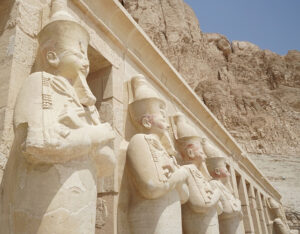
Osirid statues of Hatshepsut’s mortuary temple.
Continuing on the road to Hatshepsut’s temple, to your left are the areas of el-Khokha and el-Asasif. New tombs have been opened in the Khokha area. For me the highlight is the tomb of Kheruef in the Asasif. Kheruef was steward to Tiye, wife of Amenhotep III and mother to Akhenaten. It might be a bit of a walk as last time the police would not allow us to drive into the area.
The final, and probably the finest, is the mortuary temple of Hatshepsut at Deir el-Bahari. Make sure you visit the Hathor chapel, take time to try and discern the Punt reliefs and do visit the Anubis chapel before you venture up to the higher level. This is a spectacular temple and worth spending some time here.
To put the West Bank sites into some kind of perspective, my tours take five days to cover all these places. Next time, we shall cross the river to the land of the living and look at the East Bank.
Reach out to Ted for further information about tours to Egypt by visiting gnttours.com