
Sandra Visser takes us on a brief foodie fact-finding mission to discover what ancient Egyptians enjoyed dishing up.
BREAD AND BEER formed the basis of both rich and poor ancient Egyptians’ diet. Bread was made from wheat and barley, while the latter was also used to produce beer. Thanks to the fertile soil provided by the Nile’s annual flooding, these staple crops were easy to cultivate. Ordinary people supplemented their diets with vegetables and fish, while the wealthy could afford a greater variety of produce.
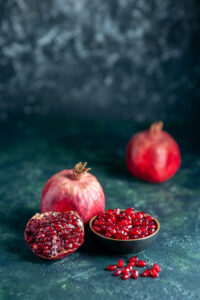
Pomegranates were a favourite delicacy.
To make flour for bread, barley or emmer-wheat grains were ground by hand using stone mills called querns. The most common type of bread was flatbread that consisted of salt, flour, and water. The dough was usually shaped into triangles but animal and human shapes were also fashioned, then baked in a clay oven. Bread could also be leavened with sourdough or yeast and topped with nuts, seasoning and seeds.
To make beer, barley was mashed and fermented in water. It was not so much a recreational drink as an important source of nutrition and therefore the ancient Egyptians’ staple drink. Their beer was thick, cloudy and had a low alcohol content – characteristics that made it more akin to the gruel consumed by peasants in the Middle Ages than the clear liquid with the high alcohol content we know today.
Apart from beer and bread, fruits and vegetables formed an important component to the ancient Egyptian diet. They cultivated onions, leeks, garlic, and lettuce, as well as legumes such as lentils, peas, chickpeas and beans. Vegetables were either eaten raw, roasted or boiled. The most common fruit was dates, but they also ate figs, pomegranates, grapes, and melons, which were either consumed on their own or used to flavour honey-sweetened cakes for dessert.
Wine was considered a luxury item because grapes did not grow as easily in Egypt as they did in other parts of the Mediterranean, such as Greece from where it was initially imported. The Egyptians later modified the cultivation techniques to suit their climate and started producing their own wine around 3000 BCE. They also produced wine using dates, figs, pomegranates or palm sap. Wine was often used in religious ceremonies and celebrations. It was also believed to have medicinal qualities.
Meat was expensive and rarely eaten – cows, goats, and sheep were kept primarily for milk to make butter and cheese. Most people ate pork, fish, and poultry such as geese, ducks, and pelicans, which were also a source of eggs (chickens only arrived from South Asia in the 5th or 4th century BCE). Cattle was primarily used for labour, and beef was mostly reserved for the elite, although the meat was sometimes distributed to the poor after it had been used in religious ceremonies.
Bibliography
Gill, N. (2025) Ancient Egyptian Cuisine and Food Habits. ThoughtCo. Available from: https://thoughtco.com/foods-in-ancient-egypt-118392 [29 March 2026]
King, A. (2024) Food & Drink in Ancient Egypt. World History Encyclopedia. Available from: https://www.worldhistory.org/article/2494/food–drink-in-ancient-egypt/ [29 March 2026]
The Oxford Encyclopedia of Ancient Egypt. (2001) Oxford: Oxford University Press. Available from: https://en.wikipedia.org/wiki/Ancient_Egyptian_cuisine#cite_note-EAEdiet-2 Internet Archive: https://archive.org/details/oxfordencycloped0000unse_t6r2 [29 March 2026]
Poo, M. (2014) Wine in Ancient Egypt. Egypt Museum. Available from: https://egypt-museum.com/wine-in-ancient-egypt/ [29 March 2026] Extracted from Wine & Wine Offering in the Religion of Ancient Egypt. Abingdon: Routledge.