
Ted Loukes shares some of the highlights visitors can expect on the West Bank in Luxor
Many of us have done those tours that include a handful of days on a cruise ship between Luxor and Aswan, and they usually include a start or finish day in Luxor itself – cramming in a handful of sites before whisking you off upriver. You’ll be lucky if you get an hour at Karnak, three tombs in the Valley of the Kings, a brief visit to Hatshepsut’s temple at Deir el-Bahari and a quick photo-stop at the Colossi of Memnon before moving on. But, you will have missed so much. Luxor, or Thebes as it was known, has so much more to offer as far as real ancient sites are concerned. Welcome to the first of three articles looking at some of these other offerings and my opinion as to whether you should go or not.
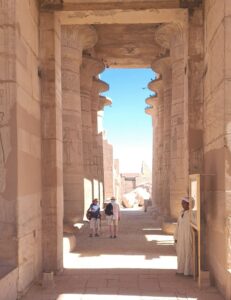
The Ramesseum interior. Picture: supplied
Firstly, know that Egypt is incredibly safe – certainly more so than many places around the world. Secondly, from a South African point of view, it is still relatively cheap.
We begin with the West Bank, the main necropolis for what is known as the New Kingdom, the age of Tuthmose III, Hatshepsut, Tutankhamun and Rameses the Great, to name just a few.
Our first oft-forgotten spot is the Valley of the Queens. There are only three open royal tombs at the time of writing, as the magnificent tomb of Nefertari, Great Royal Wife of Rameses II, is currently closed for restoration. You can leave this if you are pushed for time.
From here it is a short drive to the village of Deir el-Medina, home to the workmen who built the tombs in the Valley of the Kings. This is worth a visit as the tombs are magnificent, and there are quite a few to see. The artisans’ workmanship shows in the beauty of the tombs they built for themselves, in and around the village.
My next suggestion would be Medinet Habu. This is Rameses III’s mortuary temple. Its walls carry more than 7,000m2 of decorated reliefs detailing the king’s military campaigns against would-be invaders. Make sure you see the north exterior wall for the battle with the Sea Peoples. This is a must-see, so please allow yourself time as this temple is huge, with lots of well-preserved wall and ceiling decorations with their original paintwork.
The next area that gets ignored by most tour groups is the vast collection on the Qurna hillside known as the Tombs of the Nobles, mainly of the 18th and 19th dynasties. The open ones are ticketed in groups of three and each offers something different. These are mostly situated on the hillside and require a bit of walking; however, they are worth it. Accept the guardian’s offer to take you up on his motorbike, you won’t be disappointed. Recommended are Sennefer, Rekhmire, Nakht, and look out for one of the earliest depictions of Akhenaten and Nefertiti in the Amarna style in Ramose. They are all good, but six might be your advisable maximum.
The Ramesseum also often gets overlooked. This is the mortuary temple of Rameses the Great; it took about 20 years to build and carries scenes of Rameses’s campaigns against the Hittites, notably the battle of Kadesh. The massive statue that lies broken at the second pylon was the inspiration for Shelley’s famous poem “Ozymandias”.
Those are some of the extra sites worth looking at on the West Bank of Luxor. Next time we will continue on this side of the Nile, finishing on the East Bank of Luxor with Karnak and Luxor Temple.
For further information, email ted@gnttours.com or see https://gnttours.com