
Nerine Dorman has a glance at the life and times of one of modern Egyptology’s forerunners
FOR CENTURIES, MANY of ancient Egypt’s splendours were hidden beneath the sands, largely forgotten; however ancient Egypt’s mystique lingered, inspiring everyone from biblical scholars to historians who were able to lay hands on artefacts. One such individual was Athanasius Kircher, the “Master of a Hundred Arts”, who was born on May 2, 1601, or 1602 and passed away on November 27, 1680.
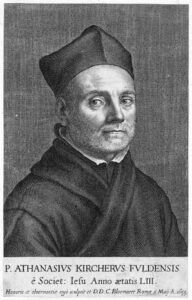
Athanasius Kircher. Picture: Wiki Commons
Kircher was a German Jesuit scholar and polymath who has been compared to the likes of Leonardo da Vinci for his incredible depth and breadth of interests, and one of his fascinations was the study of ancient Egypt. It can be said that he’s responsible for opening the door for many who followed, even if the conclusions that he drew at the time are, in hindsight, patently wrong.
He was a man who was deeply fascinated by the world around him, his work leading him to attempt deciphering ancient Egyptian hieroglyphs. He might’ve had the wrong end of the stick with these, but he did link Coptic to ancient Egyptian – so that’s one point in his favour.
In addition to ancient Egypt, his studies saw him immersing himself in geology, biology, medicine, technology, Sinology, and biblical studies, and he even took a stab at deciphering the fabled Voynich Manuscript – in many ways making him a latter-day Renaissance man.
One of the great cultural tragedies we can experience is the loss of a language. The last known ancient Egyptian hieroglyphs to be inscribed date to around 394 CE at the temple of Philae in southern Egypt. These were carved by Nesmeterakhem, a priest, who made two inscriptions – one written in hieroglyphs and the other in demotic, accompanied by a drawing of the Nubian deity Mandulis.
After that, the use of hieroglyphs fell out of favour, and so, too, did their understanding fade from memory. At least, until the efforts of 19th-century scholars Thomas Young and Jean-François Champollion – but that is a story for another time.
What matters is that Kircher, although we now know that he didn’t quite get things right, represents the first attempts of modern folks to gain an understanding of ancient Egyptian hieroglyphics, and he most certainly led the way for those who followed in his footsteps.
Before Kircher, there was, however, the Greek grammarian Horapollo (408–450 CE) who authored the work Hieroglyphica, which was translated into Greek by Philippus in the fifth century CE – a text that surfaced in the 15th century and did the rounds with those of a scholarly bent that saw it translated into Latin. While its contents have later been proved to be ‘confused, and with baroque symbolism and theological speculation’1 it can nonetheless be considered a valid attempt to decipher the ancient writing system.
In terms of early Egyptological studies, Kircher is known for his works, such as the Prodomus Coptus (1636), in which Kircher explored the connection between the Coptic language and others, such as Arabic, Classical Armenian, Ge’ez, Samaritan Hebrew, and Syriac2. Kircher’s Lingua Aegyptiaca Restituta (1643) focused on the Coptic language, also sought to address mistakes in Prodomus, and attempted to illustrate connections between ancient Egyptian and Babylonian and Indian names for stars. In the Obeliscus Pamphilius (1650) Kircher took a stab at translating the hieroglyphs on an Egyptian obelisk that had been erected in the Piazza Navona in Rome which he had been tasked with restoring. His work culminated in the publication of the Oedipus Aegyptiacus (1652–54), which drew on such esoteric subject matter as Chaldean astrology, Hebrew kabbalah, Greek mythology, Pythagorean mathematics, Arabian alchemy, and Latin philology3.
While these works were certainly ambitious and can be considered serious attempts at deciphering the ancient Egyptian language and writing systems, in hindsight he got much if not most wrong. And for all his claims to knowledge, he never did visit Egypt, whose vast history at that time still lay buried beneath desert sands. For his primary sources Kircher drew upon material collected by others – most notably the traveller Pietro della Valle.
What cannot be denied is that he was a gifted linguist, for by the age of 16 he had come to grips with Latin, Greek, and Hebrew while studying at the Jesuit gymnasium in Fulda, and it is through his work that the link between the Coptic language and ancient Egyptian hieroglyphs was made – an important connection.
Kircher, however, regarded the hieroglyphs as purely symbolic as opposed to a fully formulated written language as we now know, thanks to the work done translating the Rosetta Stone many years later. However, at the time, he was viewed as somewhat of a genius when it came to all things Egyptian, so any inaccuracies on his part were likely brushed under the carpet. One example is his use of the Bembine Table of Isis, a bronze tablet with enamel and silver inlay.
Years later, as we gained more knowledge of the ancient Egyptian language, it was shown that the tablet is not in fact ancient Egyptian at all, but likely manufactured in Rome, and none of its symbols make any sense nor would they be at all helpful to Egyptologists beyond offering an anthropological curiosity.
Even if Kircher’s love of ancient Egypt didn’t result in tangible results in terms of understanding the hieroglyphs as a complex language, his efforts do represent an attempt in our modern era to study ancient Egypt. We can at least thank him for linking the Coptic language to ancient Egyptian and helping to foster a love for all things Egyptian.
_________
1 https://en.wikipedia.org/wiki/Horapollo
2 https://en.wikipedia.org/wiki/Prodromus_Coptus
3 https://en.wikipedia.org/wiki/Oedipus_Aegyptiacus