
TESSA member Jane Mulder takes a deeper look into the ancient Egyptian artefacts that have found their way to Rome
ROME, A CITY of many appellations, the most traditional of which is “The Eternal City”, a sobriquet coined in the 1st century BCE by the Roman poet Tibullus. Home to many ancient monuments, sculptures, fountains, churches, mausoleums, piazzas and more, not to mention the magnificent St Peter’s Basilica, it is a cornucopia of manifest history.
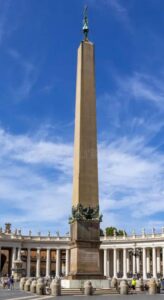
The obelisk as it stands in St Peter’s Square.
Its official founding date is 753 BCE, and who doesn’t know the legend of the twin brothers Romulus and Remus who were nurtured by a she wolf? But the history of this great city goes back even further than that. There is archaeological evidence that there was settlement on the Palatine Hill as early as the 10th century BCE.
The earliest structure still existing in Rome is the world’s oldest sewage system, the Cloaca Maxima, said to have been built in the 6th century BCE at the behest of the Roman king, Tarquinius Priscus. The next oldest surviving Roman monument is the 4th century BCE defensive Servian Wall, built after the Gauls sacked Rome. But old as these structures are, they don’t come even close to the antiquity of other structures in Rome.
These are the Egyptian obelisks. The oldest is the 3,400-year-old Lateran Obelisk which was originally erected at the Temple of Karnak during the reign of the pharaoh Thutmose III (1479–1425 BCE), and completed by Thutmose IV (1400–1390 BCE). In 357 CE it was taken from Egypt and transported to Rome by Emperor Constantine II, and was erected in the Circus Maximus.
There are seven Egyptian obelisks in Rome, and five Roman obelisks, the oldest of the latter dating to 1st century CE. Thus there are more ancient obelisks in Rome than anywhere else in the world. But there is one Egyptian obelisk that stands out from the rest. We know it as the Vatican Obelisk. At 25.3m tall it is the second highest in Rome, and is the only one that has never fallen. It stands proudly as the focal point in St Peter’s Square pointing skyward, as it was always meant to do. But what is different/strange about this obelisk is that it originally had no inscriptions, and it is therefore not certain which Egyptian pharaoh erected it.
In Book 36 of his Naturalis Historia, Pliny the elder wrote of the obelisks of Heliopolis, which of the pharaohs commissioned them, and how they were built and transported. He said that two of these, erected by Zmarres and the other by Phius, were without inscriptions, as was an Alexandrian obelisk erected by Ptolemy Philadelphus (285–246 BCE). Of those that were taken to Rome, he describes the method and difficulties of transporting these huge monoliths, and where they were placed.
According to him, there were three Egyptian obelisks in Rome, the third one of which (believed to be the Vatican obelisk) had originally been erected in Heliopolis by Pharaoh Nencoreo, son of Sesosis (thought to be Pharaoh Amenemhet II (1929–1985 BCE). Between 30 and 28 BCE the Vatican Obelisk was moved from Heliopolis to Alexandria, where Cornelius Gallus erected in the Forum Giulio, where it remained until the Roman emperor Caligula transported it to Rome in 40 CE to decorate the centre of his private circus (later called the circus of Nero).
At some time during the Middle Ages, a bronze globe, which was later believed to contain the ashes of Julius Caesar or of Roman emperor Trajan, was placed on the top of the obelisk. After the area around the obelisk fell into disuse, it was moved to the Rotonda di Sant’Andrea near the old St Peter’s Basilica.
In 1586, Pope Sixtus IV had the obelisk moved to St Peter’s Square in front of the new Basilica of St Peter, which had been built in place of the old Basilica. The globe was removed, and on inspection was shown to contain no ashes. (The globe is now in the Capitoline Museum.) A cross was affixed in its place. The moving of the 330-ton obelisk took 13 months of preparation by architect Domenico Fontana, assisted by astronomer Ignazio Danti.
With a massive wooden framework to support the monolith, a rope-and-pulley system, precision timing, and silent concentration, it took 905 men, 160 horses and 48 capstans to achieve the monumental work, which, incredibly, was accomplished in a single day. The monument is composed of four elements, that is the three-step plinth, the pedestal, the socle, and the obelisk itself. There are a number of inscriptions – on the obelisk itself, on the pedestal, and on the plinth.
The oldest inscription, incised in Latin on the shaft of the obelisk after its move from Egypt to Rome, translates as Sacred to the Divine Caesar Augustus, son of the Divine, to Tiberius Caesar Augustus, son of the Divine Augustus. The gold-plated inscriptions on the four sides of the pedestal describe the obelisk’s rededication in 1586, as well as the religious formulas intoned to exorcise it during its consecration.
The four decorative bronze lions at the corners of the obelisk’s socle were designed by Prospero Antichi, and in 1723, under Pope Innocent XIII, four bronze swags and eagles, designed by Lorenzo Ottoni, were added on each side at the foot of the obelisk. Ironically, despite of the obelisk being a manifest symbol of the Egyptian sun god Ra, its relocation was seen as a symbolic triumph of Christianity over paganism, and epitomises the Vatican’s role as the heart of Catholicism.
It is the focal point for religious gatherings, such as papal audiences, Catholic processions, and Easter and Christmas celebrations. At times it is illuminated, bringing it into sharp focus. The ancient pharaohs would have been tickled pink!