
Author Del Blackwater, in conversation with Nerine Dorman shares her fascination with ancient Egypt in an adventure that spans centuries
Nerine Dorman: Tell us a little bit about yourself and where your love for ancient Egypt stems from.
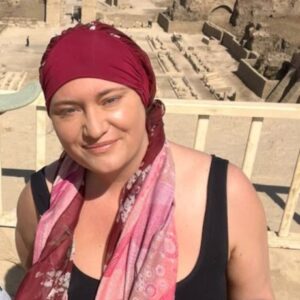
Del Blackwater
Del Blackwater: I was raised in the 1980s, and unusually for the era, my parents were incredibly strict about what I was allowed to watch as a kid. Cecil B. Demille’s The Ten Commandments made the cut, of course, but I don’t imagine they realised I was watching it for Yul Brynner and the Egyptian aesthetics! I was, like many people, drawn into the aesthetics of ancient Egypt – the architecture, the clothing, the religious iconography and, if I’m being honest, heavy eye makeup on both genders. Once I started biking to my local library to read more about these mysterious Egyptians, I realised their world view was the same as mine, meaning that all species should be considered sacred and not only the cool animals such as the lion and the eagle, but even the little guys, like beetles, and the fish in the river. All were the creations of Atum-Ra, and all species deserved temples, protection, reverence, and even staff. I remember wishing all cultures revered the natural world to that degree.
From that point on, Egypt dominated my childhood and it was understood by all that I was going to be an Egyptologist when I grew up.
ND: What was the ‘aha’ moment that struck you when you knew you had to write this story?
DB: I came down with multiple sclerosis quite young. I was only 25 when I became symptomatic. When I was at the lowest point in terms of my physical health, I decided it was time to write my magnum opus, just in case. I asked myself what I really knew enough about to get a book out of, and Egypt was really the only subject I felt I could tackle without further research. You can laugh; I’m laughing, too. The research never ended, of course, and it was a beautiful miscalculation. The decision to write a historically accurate fantasy series set in Egypt in the early 20th century changed my life in innumerable ways. The Dead Egyptians series took me to Egypt for five research trips between 2017 and 2024, and brought many wonderful humans into my life as well.
ND: Did your research for the novel lead you down any rabbit holes?
DB: Absolutely. When I first started researching Egyptology, I don’t think I could have defined what I was looking for exactly. I knew there was something there that I was supposed to discover, but I could not have defined it. I just kept going.
One day, I was in a bookstore in Milwaukee, and I saw Joan Grant’s book Winged Pharaoh lying on its side. I noticed the winged sun disc on the cover, devoured the book, and nothing was ever the same again. That book made me realise that the thing I was really after, was knowledge of what the priests and priestesses actually learned in the temples. I didn’t care about building pyramids or mortuary temples; I cared about mysticism and I became obsessed with ‘knowing what they knew’.
ND: What’s your favourite ancient Egyptian period and why?
DB: I am an Old Kingdom nutcase through and through. Anyone that’s read Dead Egyptians knows that Imhotep is my personal hero, so naturally I gravitate to dynasties three through five, the golden age of Egyptian sages. If you think of Imhotep as the father of all things Egyptian and you think of Ptah-Hotep as the last great thinker of the Old Kingdom, there’s so much to study just between the two of them. When you add in the mysteries of the pyramid age, and the sublime artistic innovations, you could lose a lifetime in there. I have a soft spot for Pharaoh Sneferu as well. If you go by the folk legends around him, he definitely comes off as a man with a sense of humor and a love of life.
ND: If you could visit Egypt for a two-week trip, what are some of the sights that are on your bucket list? And why…
DB: This question makes me miss Egypt so much. If I could go back this instant, I would love to sail Lake Nasser and see the crocodiles. Not during nesting season! I would also love to explore the eastern desert – I’ve explored the oases of the western desert, but for some reason, I’ve yet to explore the chapels and quarries between the Nile and the Red Sea. The quarry and chapels at Gebel el-Silsila are also calling me; I’ve heard such wonderful stories about the area over the years.
Lastly, I always make a pilgrimage to Abydos when in Egypt; it would feel strange to go all the way to Egypt and skip Abydos, which I often refer to as the real ‘Djeser-Djeseru’, or most sacred of the sacred.
ND: What are some of the themes prevalent in Dead Egyptians?
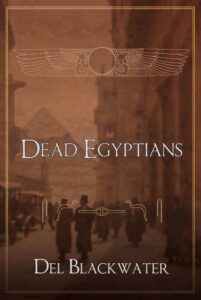 DB: It always bothered me that historians write endlessly about ancient Egypt, but once Cleopatra loses to the Romans, we never hear about Egypt again. I decided to write about the birth of modern Egypt, i.e. the Egyptian Revolution of 1919, over the course of a seven-book series. Dead Egyptians is the first book in that series. It sets up the struggle for Egyptian independence.
Parallel to Egypt’s story is my protagonist’s story. Albion Stanley is a polyglot and Seer, and through the course of meeting the spirits of dead Egyptians (primarily Imhotep), Albion learns that reincarnation is real and he will not break the cycle until he can master seven ‘truths’, one of which is giving up the thing you love most in the world. Put simply, it is the story of a man who loves a ghost, but won’t become like his lover until he can master seven spiritual teachings.
ND: Are you planning to write any other speculative historical works set in ancient Egypt?
DB: Volume two of the Dead Egyptians series, Sekhem, will be out late in 2026. Aiming for a November release at present.
Most of the action is in Luxor, surrounding the Theodore Davis excavations in the Valley of the Kings. I got a lot of mileage out of the antiquities trade at the time. Simultaneously, though, the Egyptian revolution truly begins, propelled forward by the Saqqara incident in 1905 and the Denshawai incident in 1906. There is also a mummy running around, just for fun. Lastly, my readers demanded a less challenging plotline and more romance, which I was happy to provide.
ND: If you had a past life in ancient Egypt, who would you have been?
DB: If I was answering ‘blindly’, I would say I must have been a crocodile priest or priestess, because I’ve always had a affinity for and comfort level with those animals which defies logic. I love the big, scary animals and I always want to protect the animals that tend to get hunted and persecuted. Within reason, I’ll add. I would have supported attracting dangerous animals to certain areas, so that they were protected and humans were also protected in turn.
Interestingly, though, I actually did ask multiple psychics this exact question, and two psychics both provided the same story independently of the other. Twice, I was told that I was a general in the Ramesside era. During a chariot battle, the formation that was supposed to protect me broke off to rescue a fallen soldier. They weren’t supposed to break formation, and I ended up with an arrow in the back. I fought on, despite the arrow in the back, and became even more well-respected after the incident. If the story is true…