
Peter Loyson explores the fascinating story of Cleopatra’s daughter, and her eventual fate
Cleopatra must be one of the most famous queens of ancient Egypt. She was the last queen of the Ptolemaic Dynasty and was actually Cleopatra VII, as there were six others by that name who preceded her as queen. This Greek-speaking dynasty originated from the conquering Alexander the Great, who carved out a vast empire from Egypt to parts of India. When he died unexpectedly in Babylon in 323 BCE, his vast empire was divided among his generals, and Ptolemaios received Egypt and started the Ptolemaic Dynasty. This lasted from 305 BCE to 30 BCE and ended with Cleopatras suicide. After that, Egypt became part of the Roman Empire.
Cleopatra (Greek: Glory of the father) must have been a captivating woman as she had relations with two of the most powerful men in the Roman world – Julius Caesar and Marc Antony. She has been the subject of numerous films, and her role was played by stars such as Elizabeth Taylor and Sophia Loren. However, generally not much is known about her children. This article will explore Cleopatra’s children, more specifically her daughter, who became a queen in her own right.
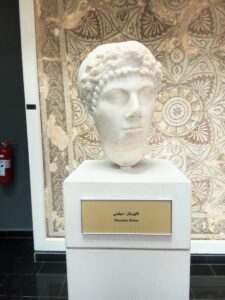
Cleopatra Selene II, wife of Juba II of Mauretania, from the Archeological Museum of Cherchell, Algeria. (Hichem Algerino/Wiki Commons)
Cleopatra’s children
From her relations with Julius Caesar she had a boy named Caesarion (little Caesar). After Cleopatra’s death in 30 BCE the conquering Roman Octavian, future first emperor Augustus, had her son executed, aged 17, since he was too much of a risk, being the son of Julius Caesar.
From her love affair with Marc Antony, she had three children: first a set of fraternal twins, a girl called Cleopatra Selene (selene = moon in Greek), officially Selene II since there had already been a Cleopatra Selene in the earlier Ptolemaic Dynasty and a boy named Alexander Helios (helios = sun). Four years later, another child was born: Ptolemy Philadelphus.
After the deaths of Cleopatra and Marc Antony, following the sea battle at Actium in 31 BCE between the combined naval forces of Cleopatra/Marc Antony and the Roman forces under Octavian, and the subsequent incorporation of Egypt into the Roman Empire, the three younger children, aged 10 and 6, were taken by Octavian to Rome, where they appeared in his triumphal march in 29 BCE. There is no further mention of the boys in the historical record. It is unlikely that Octavian had them executed, and they probably succumbed to the extreme weather conditions in Rome compared to those in Egypt. So, the only surviving child from Cleopatra was Cleopatra Selene.
Early life in Rome and marriage
Cleopatra Selene was raised in the household of Octavia, the emperor’s sister and former wife of Marc Antony, who would gain the reputation of looking after other people’s children, especially those from her former husband Marc Antony. This household would consist of Marc Antony’s son from his first wife, Fulvia, and two of his daughters by Octavia, two daughters from Octavia’s first marriage and several other youngsters of defeated royal families. Finally, there was Gaius Julius Juba, the son of Juba I, king of Numidia, a kingdom in North Africa, whom Julius Caesar had defeated, after which he brought the infant Juba to Rome to be Romanised. This child would later become a noted scholar.
These children, including Cleopatra, would all receive a brilliant education, covering Greek and Latin literature and the subjects required to help them in later life in leading roles.
Juba and Cleopatra Selene had much in common: she was the daughter of an important queen, while he was the son of an African king. Both were orphans, well-educated, and brought up in an affluent home in Rome, with close contact to the imperial family. They married in 25 BCE, when she was 15 and he was 23.
The client kingdom of Mauretania
The emperor Augustus created a new client kingdom out of two former African kingdoms in North Africa and called it Mauretania, covering large tracts of present-day Algeria and Morocco. Since Augustus had a high regard for both Cleopatra Selene and Juba, he appointed them queen and king of Mauretania, and they were both perfectly suitable to the task.
There were originally two capital cities, renamed Caesarea in honour of the emperor, and Volubilis, more inland in the western part of the kingdom. The married couple chose Caesarea, now Cherchell in Algeria, as their capital, and it would soon develop into a cultural centre, modelled according to Alexandria with its lighthouse, palaces, library, and temples under the guidance of Cleopatra Selene. Juba, officially Juba II to distinguish him from his father Juba I, would immerse himself in intellectual pursuits and write a number of works related to his investigations.
In Caesarea there were temples, including a temple of Isis, the Egyptian goddess; a theatre, where comic and tragic plays would be performed, including poetry recitals and dance competitions; the royal library would contain Latin and Greek works as well as works written in Punic, confiscated from Carthage when Hannibal lost against the Romans at the battle of Zama in 202 BCE.
Coins of the period show the royal couple as equal partners. From these coins it is noted that the queen used her Greek tradition with her name given as Cleopatra Basilica (Greek for queen), while Juba instead used Latin with Rex Juba (Rex is Latin for king).
The royal palace received embassies from as far as India and China, with exotic goods from those far-away places, such as silk. Juba himself embarked on many expeditions inland to explore his kingdom. He also launched expeditions to the Canary Islands on the west coast and even explored Arabia. He suggested that the Nile originated in his kingdom, a theory later disproved, but this was an attempt to unite his kingdom with that of his wife’s home country.
Trade between Mauretania and Rome
Mauretania, together with Sicily and Sardina, would be the main grain suppliers to Rome; besides this Mauretania would supply Rome with olives, tuna and the well known “garum” fish sauce.
Factories on the Purple Islands, just off the western coast of the kingdom in the Atlantic, would crush and process the sea snail, called murex, to obtain excretions from them, which was used in the production of Tyrian purple, a dye used to colour the edges of Roman togas. One of those islands was called Morador, now Essaouria, just off the coast from Morocco.
Further exports to Rome were citronwood (from which beautiful tables were made, inlaid with ivory), horses and gems. A gem cutter, Gnaios, working at the palace, produced an exquisite portrait of the queen engraved on a red carnelian.
Finally, a noted export was tableware, called “terra sigillata” consisting of urns ranging from pale orange to bright red, with figures incised onto the clay surface.
Aqueduct
In true Roman fashion, engineers would search the surroundings of the capital for sources of water for the city. In this case, they located a spring high up in the mountains to the south of Caesarea. The distance was 45km at a height of 131 metres above the city. During the time of Cleopatra and Juba, the Romans constructed an aqueduct which reached the city at an altitude of 40m. This was one of the longest aqueducts in Africa. Since the supporting pillars were not erected on solid rock, and the terrain was prone to torrential rain in winter and dry summers, landslides occurred which caused sections of the aqueduct to collapse. About a 100 years later, the aqueduct had to be rerouted, containing five bridges, some of the remnants of which are still visible today, but generally in poor condition.
Euphorbia
Cleopatra Selene’s personal physician was Euphorbus. On Juba’s many expeditions into the Atlas mountains they discovered a plant genus, called Euphorbia, covering many different flowers and plants, including the bright red poinsettia flower. The sap of these plants has medicinal properties and forms part of a traditional Chinese medicine. Juba and Cleopatra named the plant after Euphorbus.
Juba’s literary output
As noted before, Juba the king became a noted scholar in his time. He was called “rex literatissimus”, which means a king interested in literature. Pliny the Elder, the Roman writer who wrote an encyclopaedia of natural history said of him that he was more remembered for the quality of his scholarship than his reign. Plutarch called him “the most learned of all kings”.
Most of his works have been lost but about 100 fragments of his work can be found in the works of Pliny, Plutarch, and others. He wrote in Greek, the language of scholars in those days. He wrote 15 books or collections showing that Latin was derived from Greek, giving numerous examples. He wrote on Roman archaeology and eight books or pamphlets on painting. Fascinated as he was by the theatre, he wrote 17 works on theatrical history.
Regarding the history of exploration, he wrote on Hanno’s expedition: during the 5th century BCE, a Carthaginian sea captain tried to sail around Africa in a counterclockwise manner, but when he reached present-day Cameroon, they were confronted by an erupting volcano and were attacked by angry gorillas. At that point they turned back for home.
His most famous work was Libyka, the description of Africa, as far south as possible, describing his kingdom from the west African coast to Egypt. The central theme of Libyka was the concept of linking Egypt and West Africa, the Nile and Mauretania. He thought that the Nile originated in Mauretania and disappeared under the surface of the desert to much later re-emerge.
His final work was On Arabia, covering the geography from the Nile to India. He wrote about natural history, cultural history, trade, and commerce. Central to this work was the Roman interest in the routes to India.
Further activities and death of Cleopatra Selene
As her husband spent his time on scholarly pursuits and explorations, Queen Cleopatra Selene was left to run the country in all its aspects, communicating with Rome. She handled all correspondence and may have visited Rome several times to liaise with the emperor Augustus and the imperial family.
After 20 years of reign with her husband, Cleopatra Selene died during a lunar eclipse, aged 35. Possible dates for lunar eclipses in the region are 5 BCE, 1 BCE, 3 CE and 7 CE. Consensus seems to be 5 BCE.
The court poet Crinagoras wrote a beautiful poem to commemorate her death, and she was buried in a grand tomb, built by Juba, located in present day Tipaza, Algeria. When Juba died in 23 CE, his body joined hers in this tomb. Later, this tomb was robbed and the corpses removed. No trace of them was ever found.
Cleopatra’s descendant
Cleopatra Selene and Juba had one son, called Ptolemy of Mauretania. He ruled with his father after Cleopatra’s death, and when Juba died, he took over the reign and appears to have been a capable ruler. On a visit to Rome in 40 AD, he was murdered on orders of the Emperor Caligula. The following year, Caligula himself was murdered. The next emperor, Claudius, dissolved the kingdom of Mauretania in 44 CE and annexed it to Rome, thereby abruptly ending a client kingdom that had prospered for 69 years, first under the guidance of Cleopatra Selene and her husband Juba then later under their son Ptolemy.
References
Cleopatra’s Daughter by Jane Draycott, 2022
The Fall of Egypt and the Rise of Rome by Guy de la Bédoyère, 2024
Cleopatra’s Children by Diane Bentley in Ancient Egypt Magazine, July-August 2025
Cleopatra’s Daughter by Jane Draycott in History Today, April 2013
“The World of Juba II and Cleopatra Selene” Duane Roller, Routledge Classical Monograph, 2003
C.W. Passchier: article entitled “Cherchell on the aqueduct in Caesarea”, internet
Various internet sites