
Professor Henry Colburn shares his thoughts on the 27th Dynasty pharaohs
Writing in the early Ptolemaic period, the Egyptian priest and historian Manetho described the beginning of the 27th Dynasty thus: ‘Cambyses in the fifth year of his kingship over the Persians became king of Egypt, and ruled for six years’. This straightforward remark belies the fact that, for the first time, Egypt had become part of a larger political entity whose capital lay far from the banks of the Nile. Yet for Manetho, the Persians were simply another dynasty of rulers. This apparent contradiction encapsulates the challenge of studying the 27th Dynasty: on the one hand, the conservative nature of Egyptian culture seems to have continued unabated, while on the other it is clear that Persian rule had a notable impact, and Egypt was never the same again.
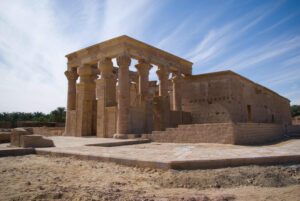
The temple of Amun at Hibis, Kharga Oasis, ca. 521–486 BCE. Picture: A Sartan
The Achaemenid Persian Empire was founded in southwestern Iran ca. 559 BCE by Cyrus, the king of Anshan, an Elamite city located at modern Tall-e Malyan. In the ensuing three decades he conquered the major states of the Near East, especially Media, Lydia, and Babylon, and by the time of his death in 530 he ruled a territory stretching from modern Türkiye to Afghanistan. His son and successor Cambyses (r. 530–522) added Egypt to the empire in 526, but in the aftermath of this invasion a revolt broke out back in Persia, and Cambyses died on his way home to quell it. His successor, and perhaps one of the architects of the revolt, was Darius I (r. 521–486), who claimed descent from a common ancestor with Cyrus named Achaemenes, almost certainly a ruse, from which the modern name of the dynasty derives. Egypt remained part of the Achaemenid Empire until ca. 404, and was conquered again in 340 by Artaxerxes III (r. 359–338), bringing an end to the 30th Dynasty; Persian rule in turn was ended for good with the arrival of Alexander the Great in 332.
On the surface, relatively little changed in Egypt under the Persians. The Achaemenid kings presented themselves as traditional Egyptian pharaohs. They adopted Egyptian royal titles, for example, and Cambyses performed obeisance before the goddess Neith in her temple in Sais, the hometown of the kings of the 26th Dynasty. This is according to an inscription on the statue of a courtier named Udjahorresnet, who evidently advised both Cambyses and Darius and composed their Egyptian titles. Cambyses and Darius were also both involved in the funerals of Apis bulls, the animal incarnation of the god Ptah, at the Serapeum of Saqqara, despite Herodotus’ (3.27) story, probably derived from a hostile Egyptian source, of Cambyses killing the bull. Darius was responsible as well for the construction or enlargement of temples at Elkab and in the Kharga and Dakhla Oases in the Western Desert; there is also evidence for building work on temples in the southern Kharga and on the House of Apis in Memphis during the second half of the fifth century. One of the temples constructed by Darius, the temple of Amun at Hibis, is one of the best preserved in Egypt. Its extensive decorative programme reveals little indication of Persian involvement in its construction.
As the Persian king rarely set foot in Egypt, the province was ruled on his behalf by a governor who operated out of the Palace of Apries in Memphis. Sometimes, even these governors were absent; Arshama, who governed Egypt for much of the second half of the fifth century, is best known from the letters he wrote to his subordinates in Egypt, which clearly indicate that he was elsewhere for much of his tenure. The letters, written in Aramaic on parchment, which could withstand the rigors of travel far better than papyrus, illustrate how the Persian administration interacted with local officials, who were mainly Egyptians. Indeed, a number of Egyptian administrators and bureaucrats are attested in this period, from papyri and from hieroglyphic inscriptions on statues. Udjahorresnet was one such official; others include Horwedja, who was senty (usually translated as ‘planner’; presumably a financial office) under Darius I, and Ptahhotep, ‘Overseer of the Treasury in Memphis’ for the same king. The statues of Horwedja and Ptahhotep provide an illuminating contrast in how these officials reacted to Persian rule. Horwedja is depicted in typical Egyptian attire: a kilt, bare chest and a bag wig. Ptahhotep, in comparison, wears a long robe over a sleeved jacket, and around his neck, in addition to an Egyptian pectoral, he has a torque decorated with ibexes. His clothing, therefore, has a decidedly Persian flavour to it. Although the robe and jacket have Egyptian antecedents, together they mimic the garments worn by Persians, and the ibex-headed torque is a well-known type of Persian jewellery. The implication of these two statues is that while both men served the Persians, Ptahhotep saw himself as one (in addition to being Egyptian, of course), while Horwedja did not.
Such multicultural identities were probably quite common in this period. Even before the arrival of the Persians there were Greeks, Carians, and Phoenicians resident in Egypt. The Greek trading post at Naucratis was already established by the late seventh century, and Herodotus (2.112.2) refers to a Phoenician neighbourhood in Memphis (which he calls the ‘Tyrian camp’) with a temple of Astarte. The Persians contributed to this cosmopolitan environment by installing foreign communities in key locations across Egypt. For example, the Judean community at Elephantine at the first cataract of the Nile monitored the province’s southern border. Similarly, an Arabian community at Tell el-Maskhuta in the eastern Nile Delta was likely responsible for controlling traffic along the canal connecting the Red Sea to the Nile. Papyri also refer to various other peoples, including Aramaeans, Hyrcanians, and Caspians, all likely in Egypt in service of the empire.
There were several significant innovations in this period as well. Perhaps the most remarkable was the digging of a canal between the Nile and the Red Sea. According to Herodotus (2.158), this was first attempted unsuccessfully by the Saite pharaoh Necho II (r. 610-595), and only completed by Darius. The course of the canal was marked by stone stelae containing both hieroglyphic and trilingual cuneiform inscriptions (in Old Persian, Elamite, and Akkadian). The inscriptions are quite fragmentary, but they do indicate that the canal’s intended purpose was to create a sea route between Egypt and Persia. Furthermore, the hieroglyphic text on the stela from Tell el-Maskhuta mentions Saba’, an ancient kingdom in what is today Yemen which is often identified with the land of Sheba in the Hebrew Bible (1 Kings 10:1–13; 2 Chronicles 9:1–12). Saba’ was a major exporter of incense, frankincense, and spices, and the canal facilitated the shipment of these products to Egyptian ports, whence they were likely sold to Greek merchants or transported elsewhere in the Persian Empire.
A second innovation was the introduction of qanat irrigation. A qanat is an underground tunnel running downslope from an aquifer to a cistern. They are made by digging a series of vertical shafts, which are then connected by the tunnel; these shafts also allow for maintenance and cleaning. Although they are difficult to date on archaeological grounds (after all, how does one date a hole in the ground?), it is fairly clear that they originated in Iran in the second millennium BCE and were not in use in Egypt prior to the 27th Dynasty. Under Persian rule, however, the qanat appears in the Kharga and Dakhla oases, where it supported the development of several towns, including Hibis and ‘Ain Manawir. The Demotic ostraca from ‘Ain Manawir indicate that the water supplied by these irrigation works was leased to local farmers, some of whom grew castor beans, a cash crop used to make lamp oil. These ostraca also suggest that the Persians introduced the use of the dromedary to Egypt, presumably in order to make the trip across the desert from the Nile Valley to the oases with ease. Together these allowed the Persians to take complete control of the oases, which in the past had served as bases for usurpers and rebels.
Third, a side effect of Persian rule was the adoption of coinage. This occurred in a roundabout manner. According to Herodotus (3.91.2), the Egyptians (along with Cyrene in modern Libya) paid 700 talents of silver (about 21,000kg) in tribute to the Persians every year. While the amount is far from certain, the fact that it was paid in silver is indisputable, since it would only be worthwhile to transport something of relatively high value the long distance overland from Egypt to Persia. However, although it is rich in gold and copper, Egypt has few natural sources of silver. Furthermore, its greatest source of wealth was not metal at all, but grain, especially wheat and barley. Thus the Egyptians had to find a way to convert their grain into silver. They accomplished this by exporting it to the Greeks in exchange for silver coins. Indeed, the first coin hoards appear in Egypt around 500.
After 450 the hoards contain Athenian tetradrachms almost exclusively. This is because Athens was a major importer of grain in this period, when its population was at its largest and many of its citizens were manning the triremes of the Delian League’s navy rather than farming. Athens also had significant reserves of silver from the mines at Laureion, meaning coins were its primary export and Athenian tetradrachms were widely used across the eastern Mediterranean. By the end of the fifth century, they were so common in Egypt that Demotic and Aramaic documents start to explicitly equate them to Egyptian weights. After Athens began to import grain from the Black Sea and reduce its coin production due to setbacks in the Peloponnesian War, the Egyptians began to mint imitations of Athenian coins, using the same types (the images on the coins) and maintaining the same weight and purity as their Athenian prototypes. This practice persisted into the fourth century, and when the Persians re-conquered Egypt they minted imitation Athenian tetradrachms of their own, with the names of the satraps Sabaces and Mazaces written on them in Aramaic.
There can be no doubt that Persian rule entailed the exploitation of Egypt. At the same time, there is no evidence to indicate that this exploitation was any worse than under the native pharaohs of the 26th Dynasty, or those of the succeeding 28th through 30th dynasties; arguably, it was much less oppressive than under the Ptolemaic kings. But the ancient Greek characterisation of the Persians as ‘barbarians’, especially following the Persian Wars in 490 and 480–479, was embraced by generations of Egyptologists, with the result that this fascinating period has long been overlooked and misunderstood.
Professor Henry Colburn wrote this article especially for SHEMU while he was a passenger on an aircraft. He is the adjunct assistant professor of the Department of History, Hofstra University.