
The Egyptian chariot was used for warfare, hunting and sports. Besides that, it particularly was the supreme mode of locomotion for the elite in the New Kingdom for private and public purposes. In most cases, men are shown on chariots, but there is some evidence for women on chariots as well.
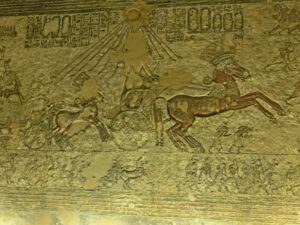
The royal couple Nefertiti and Akhenaten, each alone on their chariot, depicted in the tomb of Merire I in Amarna.
HEIDI KÖPP-JUNK
THE ANNALS OF Thutmose III already show its central importance. However, in addition to its prominent use in warfare, the chariot is also documented in other contexts: hunting, sport and as a mundane means of locomotion. In most cases, men appear on chariots. However, from the 18th Dynasty to the Graeco-Roman period, there are also texts and depictions associating women with chariots. A significant increase in sources can be observed during the Amarna period.
1 The ancient Egyptian chariot – an overview
Numerous textual references, paintings and reliefs from tombs and temples provide evidence of the appearance and uses of the Egyptian chariot. Several examples have been preserved in their entirety; six chariots alone were found in Tutankhamun’s tomb. Models, parts of chariots and individual components such as yoke knobs and more have also been preserved.
Although the wheel has been documented in Egypt since the Old Kingdom, there is no evidence of a development from four-wheeled wagon or two-wheeled carts in Egypt. The chariot appeared in Egypt without any precursors. It was pulled by two stallions and used for combat with ranged weapons such as bows and arrows or spears. The crew consisted of a driver and an archer, as can be seen from numerous depictions and textual evidence. The king often appears alone on the chariot, but it is known that Ramses II had a driver named Menna in the Battle of Kadesh.
Sometimes, the depictions show the king driving alone with the reins slung around his hips, as in the Beth el-Wali temple or in the hunting scenes at Medinet Habu, which makes him appear particularly agile. This driving style allows him to slow down while still having his hands free to fire arrows or throw spears. A certain change of direction is possible by turning to the right or left.
The Egyptian chariot was used exclusively for the movement of persons, not for load transport. The weight of the Egyptian chariot was less than 30kg, the body consisting of a wooden frame covered with leather or fabric. The Egyptian chariot from the early 18th Dynasty, now in the Museum of Florence, weighs only 24kg. Various depictions show a chariot being carried by only one or two individuals. Practical driving tests in the field of experimental archaeology have confirmed a speed of 38km/h.
Sometimes, the rear of the carriage body is half closed, as is the case with the one from the tomb of Juja and Tuja. This prevents dust and dirt stirred up by the horses’ hooves from entering the carriage body, which would otherwise drift under the chariot and up behind it. In addition, the closed surface provides protection against passengers falling out, and the surrounding frame offered further support. At 74cm, the diameter of the wheels is much smaller than that of other chariots that have been handed down. This lowered the vehicle, making it easier for the elderly couple Juja and Tuja to climb in; it was designed with seniors in mind, so to speak. A grab handle on the right rear side of the car body provided additional comfort as an entry aid.
In older publications it was assumed that the Hyksos introduced the chariot into Egypt, but there is no explicit evidence that the Egyptians adopted the innovation of the chariot from the Hyksos. Chariots are only attested in the battles between the Egyptians and the Hyksos, demonstrating that both used them at the same time, which, of course, makes perfect sense from a tactical point of view, as one does not want to be less well equipped than the enemy. Therefore, the chariot might have been introduced into Egypt from another independent source in the north, that is past the Hyksos in the Delta and avoiding them, or maybe even through the Wadi Hammamat and across the Red or the Mediterranean Sea.
2 Areas of use of the Egyptian chariot
Its use in warfare has already been discussed frequently, so we will refrain from further elaboration here. Its use outside of this area has received less attention to date.
2.1 Hunting
Both private individuals and kings used chariots for hunting. The text on the Sphinx Stela of Thutmose IV from the 18th Dynasty, also known as the Dream Stela, describes the king hunting desert animals from his chariot. One of the chests from Tutankhamun’s tomb treasure shows him not only in military conflicts, but also, in a polychrome painting on the lid, hunting gazelles, lions, ostriches and hyenas from his chariot. The reliefs on the large pylon in the Medinet Habu temple from the 20th Dynasty depict Ramses III on his chariot in two superimposed scenes, hunting wild bulls and antelopes with a bow and arrow and a spear. The lower scene shows him unusually agile, stepping with one leg over the chariot box onto the drawbar. Private individuals are also depicted hunting from chariots, as shown in scenes from Theban tombs of the 18th Dynasty.
2.2 Sports
There is less evidence in the sporting arena than in war. A stela from the Karnak Temple, now in the Luxor Museum, depicts Pharaoh Amenophis II firing arrows at a copper target. The text of the large Sphinx stela from Giza describes in great detail the archery skills of the same pharaoh from his chariot. The inscription describes four copper targets, each the width of a hand, set up at a distance of 20 cubits. The king approaches them on his chariot and pierces the copper targets with only four arrows. The text of the Sphinx Stela of Thutmose IV also mentions that he shoots at a copper target from his chariot near Memphis. There is no evidence of chariot races from the pharaonic period.
2.3 Means of locomotion in civil context
Beyond that, the chariot was the common means of passenger transport in both the professional and private sectors. Messengers used it to deliver their messages as quickly as possible, as papyrus Chester Beatty I shows. Alongside the horse, the chariot was the fastest means of transport of its time. Its speed was probably around 38km/h, while a horse can reach speeds of 45–52 km/h at full gallop. In contrast to the chariot, horse-back riding is seldom mentioned in Egypt. During the Battle of Kadesh, soldiers astride horses maintained communication between the chariot contingents.
In addition, officials used chariots as a means of locomotion within their profession, for example to bring prisoners to the vizier, as depicted in Mahu’s tomb, or to inspect field work. It was also used to carry people on their way to the temple or palace. Visiting the king’s audience by chariot is documented in Amarna and in Theban tombs. Chariots were also used to receive the gold of honour and to attend banquets. Its use in both professional and private life is thus well documented, as the tombs in Thebes and Amarna vividly illustrate.
3 Women on chariots
The majority of depictions and textual evidence refer to men on chariots. However, there is also isolated evidence of their use by women such as court ladies, princesses, queens, and goddesses. The goddess Astarte is mentioned on the outside of Thutmose IV’s chariot box. In the literary text of the Tale of the Two Brothers in the Papyrus d’Orbiney from the 19th Dynasty, a woman driving a chariot is mentioned. The king climbs into his chariot for a ride, followed by Bata’s wife in her own. Neither she nor the king is mentioned as having a charioteer in the text.
An ostracon from the 20th Dynasty in the Egyptian Museum Cairo depicts a woman together with a driver. She is armed with a bow and arrow and is shown shooting arrows at a man approaching her on a chariot. The scene is clearly to be considered a martial context. Interpretations of this woman range from her being addressed generally as a queen or as Queen Tausret, or the goddess Astarte. A temple wall in Edfu from the Ptolemaic period depicts a Sekhmet-headed goddess in a chariot, identified as Astarte based on the accompanying inscriptions.
Evidence of women on chariots during the Amarna period has so far been found in the royal sphere or its immediate surroundings. These are various depictions of Nefertiti, her daughters and court ladies. They can be found in tombs and on talatat blocks of the Temple of Akhenaten.
Further reading
Köpp-Junk, H. “Wagons and carts and their significance in Ancient Egypt”. Journal of Ancient Egyptian Interconnections 9 (June 2016): 14–58.
Köpp-Junk, H. Nofretete auf dem Streitwagen – Ikonographische und textliche Belege für Frauen auf Streitwagen in Ägypten. Aachen 2023.
Spalinger, A. “The Battle of Qadesh: The Chariot Frieze at Abydos,” Ägypten & Levante 13 (2003): 163–199.
Veldmeijer, A., Ikram. S. Chasing chariots. Proceedings of the first international chariot conference Cairo 2012. Leiden 2013.