by Nerine Dorman | Jan 19, 2026 | Shemu Articles
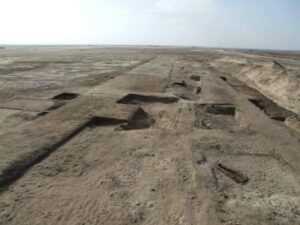
TED LOUKES THE RECENT DISCOVERY of the remains of a Ptolemaic fortress, as well as one from the Roman period, at the site of Tell Abu Saifi, east of the Suez Canal, highlights the importance of the eastern frontier defences. It is understood that this fortress...
by Nerine Dorman | Jul 22, 2025 | Shemu Articles
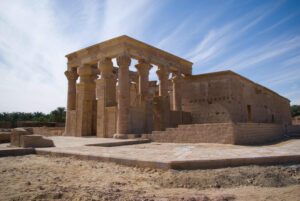
Professor Henry Colburn shares his thoughts on the 27th Dynasty pharaohs Writing in the early Ptolemaic period, the Egyptian priest and historian Manetho described the beginning of the 27th Dynasty thus: ‘Cambyses in the fifth year of his kingship over the Persians...

by Nerine Dorman | Jul 18, 2025 | Shemu Articles
TESSA member Jane Mulder takes a deeper look into the ancient Egyptian artefacts that have found their way to Rome ROME, A CITY of many appellations, the most traditional of which is “The Eternal City”, a sobriquet coined in the 1st century BCE by the Roman poet...

by Nerine Dorman | Jun 6, 2025 | Shemu Articles
Heidi Köpp-Junk shares an overview of what she believes music in ancient Egypt sounded like, based on her research. WHAT DID MUSIC sound like in pharaonic Egypt? The present article offers an overview of this topic, based on archaeological, pictorial, and textual...
by Egyptian Society | Jul 7, 2016 | Shemu Articles
By Anand Balaji The death of Pharaoh Amenhotep III of the illustrious Eighteenth Dynasty in ancient Egypt enabled his second son Amenhotep IV (r. 1353-1336 BCE) to inherit an empire of opulence. Ably assisted by Nefertiti, his Great Royal Wife, the young pharaoh...
by Egyptian Society | Apr 29, 2015 | Shemu Articles
By Jane Mulder Myths abound about the curse to be visited on those who disturb Ancient Egyptian burials, the most famous “victim” being Lord Carnarvon who died not long after he and Carter opened Tutankhamun’s tomb. But there is an even older account of a mummy’s...
by Egyptian Society | Sep 18, 2014 | Shemu Articles
By Jane Mulder When there is a dearth of concrete evidence theories will be formulated, and until further information comes to light such hypotheses often become part of the accepted record. To a certain extent this applies to the genealogy of Ancient Egypt’s 4th and...
by Egyptian Society | Sep 18, 2014 | Shemu Articles
By Keith Grenville Hatshepsut, the most famous female pharaoh, reigned for 21 years from approximately1479 BCE until 1458 BCE, 26 years before Tutankhamun and probably more than 200 years before the supposed time of Moses. Hatshepsut’s magnificent terraced...
by Egyptian Society | Oct 21, 2013 | Shemu Articles
By David Furlong In my early visits to Egypt, which started in 1991, I often used to stand on the central axis of different temples and wonder at the alignment intention of their founders. In those early days there was no simple way of determining accurately temple...
by Egyptian Society | Oct 4, 2012 | Shemu Articles
By Dr Per Stormyr In 2006 one of the most important recent archaeological discoveries in Egypt were made in Wadi Abu Subeira near Aswan. A team led by Adel Kelany of the MSA [Ministry of State for Antiquities] found a stunning assemblage of petroglyphs dating to...