
TED LOUKES
THE RECENT DISCOVERY of the remains of a Ptolemaic fortress, as well as one from the Roman period, at the site of Tell Abu Saifi, east of the Suez Canal, highlights the importance of the eastern frontier defences. It is understood that this fortress replaced the one at Tell Hebua as the course of the Nile moved. This was the great pharaonic fortress of Zarw.
Zarw, alternatively given as Tharu or Tjaru, among other spellings, is the first station on the Way of Horus, the ancient military road that leads from the eastern delta, following the old Mediterranean coastline, to somewhere near Gaza. It is believed to be the same route as the Way of the Philistines mentioned in Exodus.
The fortress has had several names over the centuries, as well as many different spellings of the same name. Most of the hieroglyphic representations for the name Tharu or Zarw include the lion glyph for the middle r; this same glyph is also used to denote the letter l. The letters dj, th and z are interchangeable; for example, Djoser is also given as Zoser, and so Tjaru is the same name as Zarw, and is the same name as the Greek Zele or Sile.
The need for solid defensive structures on the eastern approaches dates back to sometime in the early 5th Dynasty, as shown by the title Overseer of the Way of Horus found in the Giza tomb of Hekni-Khnwm. The pyramid texts of the 6th-Dynasty King Teti also mention the Way of Horus.
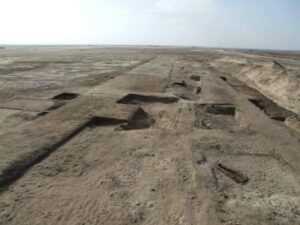
An aerial view of the Zawr discovery, 2007.
The 12th-Dynasty Tale of Sinuhe follows the adventures of a court official, Sinuhe, who, upon hearing of the death of King Amenemhat I, flees Egypt for upper Retenu and only returns as an old man. Although considered by many as a work of fiction, the story draws on real geographical locations and mentions both the Wall of the Ruler as well as the Way of Horus. On his journey east,
I gave a road to my feet northward and attained the Wall of the Prince, which was made to repel the Setiu and to crush the Sandfarers. I bowed me down in a thicket through fear lest the watcher on the wall for the day might see (Notes on the Story of Sinuhe, Gardiner, 1916).
The return journey relates how,
came this humble servant southward and halted at Paths-of-Horus. The commander who was there, in charge of the frontier-patrol sent a message to the Residence (ibid).
According to the Prophecy of Neferti, it was the same Amenemhat I, who began the construction of the Wall(s) of the Ruler/Prince on the eastern border:
They will build the Walls of the Ruler may he live, prosper, and be well, to prevent the Asiatics from coming down into Egypt (Papyrus Hermitage 1116B, Helck, 1970).
A granite block found in the Temple of Ptah in Memphis attests the Way of Horus in an inscription relating to Senusret I, the son of the aforementioned Amenemhat.
It is possible that the people known as the Hyksos, the Aamu, realising the strategic importance of Zarw, made the fortress and its adjoining citadel their capital, until it was taken by Kamose, rather than the assumed site of Tell el-Dab’a. With the expulsion of the Hyksos, Memphis became the capital once more, while the centre of religion moved south to Thebes in Upper Egypt, and Avaris became a military storage facility for the region. Only then was the fortress city renamed Zarw or Tharu. Tuthmose III mentions the fortress,
Year 22, fourth month of the second season (eighth month), on the 25th day, his majesty was in Tharu on the first victorious expedition to extend the boundaries of Egypt (Ancient Records of Egypt, vol. II, Breasted, 1906).
According to the inscriptions of Seti I, on the eastern end of the northern exterior wall of the Great Hypostyle Hall at Karnak, there were 12 major fortresses and a number of smaller forts along the route, though so far only four of these fortresses have been identified: two at Tell Hebua, a third in Bir Al-Abd and a fourth in the Kharoub area near el-Arish, the latter two being along the ancient northern Sinai coastline.
The inscriptions at Karnak show Seti returning home victorious from his campaign against the Shasu, the Canaanites. His journey passes along the Way of Horus ending at the fortress city of Zarw with its bridge over a crocodile-infested canal. From the reliefs it appears that the reed-lined canal eventually ends up joining a larger expanse of water that stretches to the next fortress, named The Dwelling of the Lion.
This has been backed up by the discovery at Tell Hebua, just to the northeast of the present-day town of Al Qantarah, of the remains of a fortress with an adjoining settlement about a kilometre away. The Arabic “al qantara” means “the bridge”. More recent excavations have unearthed administration buildings and massive granary storage facilities dating to the time of the Hyksos and the New Kingdom. The size of the storage areas shows that it was possible for a large force to have been garrisoned here. The administration buildings contained human and animal bones that show evidence of being stabbed with spears and arrows, and there is also evidence of fire damage, as is recorded in the accounts of Kamose’s attack on Avaris.
Tell Hebua II is just over a kilometre to the southeast. The two sites are separated by a depression that appears to have once contained water, showing the accuracy of the Seti inscriptions at Karnak. The site consists of a New Kingdom fortification built on Hyksos remains with a four-metre-thick wall and towers at its corners. Evidence of both Seti I and Ramesses II exist, as well as much imported and local pottery. The Egyptian pottery suggests that there was continuous occupation from the time of Tuthmose III until the Ramesside era, including evidence of the notable blue pottery associated with the Amarna period.
The canal also forms part of the defensive system of the eastern frontier and first arises in The Teaching for King Merykare from the 9th or 10th Dynasty, where the future king is urged,
Dig a canal until it is unhindered. Flood its half as far as Lake Timsah. Behold, it is in the life-line of the foreigners; its ramparts are warlike, its warriors many (Egypt and the East Mediterranean World, Ward, 1971).
Traces of an ancient canal have been discovered linking Lake Timsah to the now dried-up El-Ballah lake system and then again north to the coast at Pelusium. Ahmose, son of Abana, in his autobiography in his tomb at el-Kab, tells of a naval engagement in the canal Pazedkhu of Avaris. Avaris on the Two Rivers, as it is called by Kamose
On the relief at Karnak, the fortress before Zarw is named the Dwelling of the Lion, where the lion in question is an obvious reference to the king, Seti I. In the 19th Dynasty satirical text, the Papyrus Anastasi I, this same place is called the Dwelling of Sese. Here we see the usurpation of names, as Sese is none other than Ramesses II, the son of Seti I. The text is a series of notes from a senior scribe to a junior one, pointing out his shortcomings; the final criticism is of the lesser scribe’s lack of knowledge of the road to Canaan, the Way of Horus. The Dwelling of the Lion or the Dwelling of Sese appears again in the Papyrus Anastasi V, in a letter from two army officers to the Royal Butler. The two soldiers have been charged with delivering three stelae to the butler. The text continues,
Behold, we passed the fortress of Ramesses which is in Thel [Zarw, Sile] . . . and we shall go to empty the ships at The Dwelling Place of Ramesses. . . and drag the monuments into the presence of the Butler of Pharaoh (JEA vol 5, Gardiner, 1918).
What is interesting here is that the Dwelling Place of Ramesses is a short distance east of Zarw and has its own harbour to “empty the ships”, exactly what we find at Hebua II. The current placing of Pi-Ramesses at Tell el Dab’a/Qantir therefore doesn’t make any sense, as to get from Memphis to the generally accepted site of Ramesses via Zarw means taking a detour of about 100km. It is also understood that Avaris was a heavily fortified citadel, yet the archaeology of Tell el Dab’a has revealed no such defences. It is possible that at Hebua I and II, as part of the greater Zarw fortifications, we have found the House of Ramesses, Pi-Ramesses, built on the ruins of the Hyksos capital, Avaris, and its adjacent strategic strongpoint, Zarw.
There is considerable evidence to show that as the 18th Dynasty progressed, so the greater Zarw area grew, not just as a military position, but as a royal residence and a region noted for its wines. Remnants of wine jars have turned up in the artisanal village Deir el-Medina, and in the tomb of Tutankhamun, as well as at Amarna. One jar from Deir el-Medina reads “a good/perfect wine from Tjaru” while there were several bottles of “sweet wine of Tjaru” in the tomb of the boy king.
An early temple to the Aten seems to have been built in the city of Tharu/Zarw. Neby, the mayor of Zarw during the reign of Tuthmosis IV, was Overseer of the Foremost Water in the hnt (lake area) of the Temple of Aten. After the Amarna period, the Edict of Horemheb reveals the return of Tharu to its former role as a prison:
the law shall be executed against him, in that his nose shall be cut off, and he shall be sent to Tharu (Ancient Records of Egypt, vol. III, Breasted, 1906).
Horemheb died with no male issue, but he had named one of his viziers, a man named Paramessu, as his successor. Paramessu, from the eastern delta, was the son of a troop commander named Seti. He was a military man, holding the rank of superintendent of the cavalry, and had at one time been commander of the fortress at Zarw. Not much is known about him as his reign was short, less than two years, and like his predecessor, he was not of royal birth and his claim to the throne was not strong; however, he was destined to be the start of a new dynasty; the Ramesside era.
Additional material
Textual Sources for the Hyksos Period, Redford, 1997
A History of Egypt, vol. II, Petrie, 1896 Tharu: The Starting Point on the “Ways of Horus”, Al-Ayedi, 2000